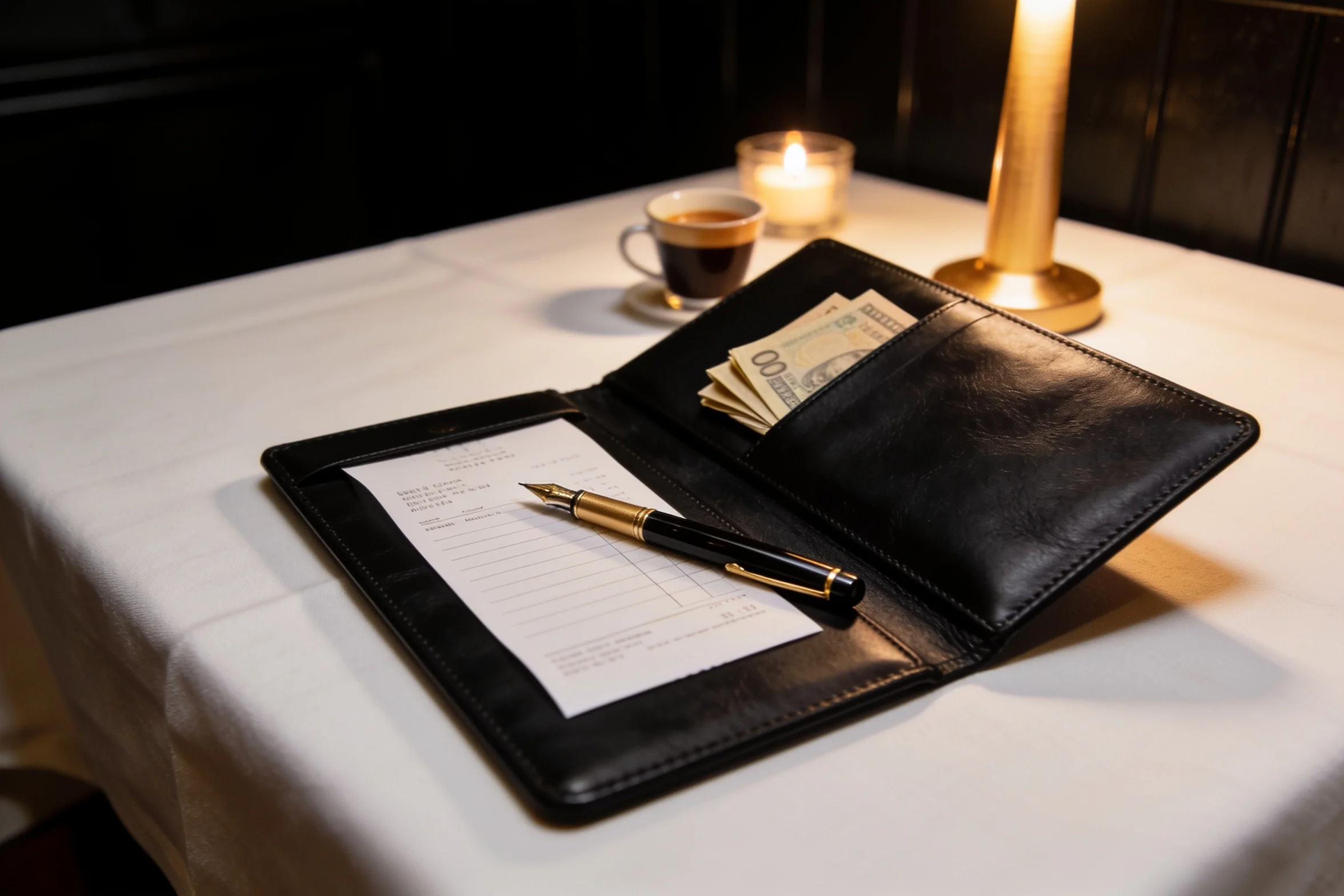
The last thirty seconds of a good dinner are the only ones anybody gets wrong. A leather folder arrives, there is a line on it you were not expecting, and a decision has to be made in front of the table. Twenty per cent, or nothing, or whatever happens to be in your pocket.
Two questions are being answered at once in that moment. What the venue is owed, which is printed on the bill and knowable. And who else did something for you tonight, which is printed nowhere and is where the awkwardness actually lives.
Read the bill before you decide anything
A bill in our cities says one of three things. A service charge has already been added, usually described as discretionary. A gratuity line has been left blank for you to fill in. Or there is nothing on it, and nothing is expected.
The expensive mistake is adding twenty per cent on top of a service charge that was already there. The cheap one is leaving a blank gratuity line blank in a city where that line is how the staff are paid. Both happen constantly, and both are solved by reading the bottom four lines before reaching for anything.
Discretionary means what it says. It is optional, it can be taken off, and asking for it to be taken off is an ordinary request rather than a scene. Ask the person handling the payment, quietly, once.
Where the tip is the wage
New York, Los Angeles, and Toronto. Twenty per cent is the working number and it is not a reward for anything, it is how the people serving you are paid. Eighteen is the floor in a good room and nobody at the table will think about it again.
The thing to check is an automatic gratuity, which most rooms add to a party of six or more and print in type smaller than the total. Pay it once. Adding a second twenty per cent underneath it is the most common way to leave a hundred dollars on a table by accident.
Where it is already on the bill
London prints a discretionary service charge, commonly twelve and a half per cent, and if it is on the bill then you have tipped. Nothing further is expected and nobody is waiting for it. If it has not been added, ten to twelve and a half is right, on the card or in cash.
Singapore usually shows a ten per cent service charge alongside the tax, and that is the end of it. Leaving nothing on top is completely normal here, which visitors find harder to believe than anything else in this piece.
Bangkok is not a tipping city by tradition, but the top of the city runs on international convention and a service charge appears on most hotel and fine dining bills. Round up for a driver, leave the coins, and do not calculate a percentage.
Dubai needs one extra sentence. A bill in a hotel restaurant, which in this city is most of them, can carry a service charge, a municipality fee, and tax, and none of those three is a tip in the sense you mean it. The service line does not reliably reach the person who served you. If you want it to reach them, hand it to them.
Where a percentage is the wrong instrument
In Paris service is included in the price by law and has been for decades. The gesture is rounding, or a few euro left on the table after a long dinner, or ten after a remarkable one. Twenty per cent in a Paris dining room is not generous, it is a visitor announcing themselves, and the waiter will be faintly embarrassed on your behalf.
Sydney works the same way with less history behind it. Nothing is expected, ten per cent marks something out of the ordinary, and a bill settled flat is the normal end of a normal dinner.
Where it comes back
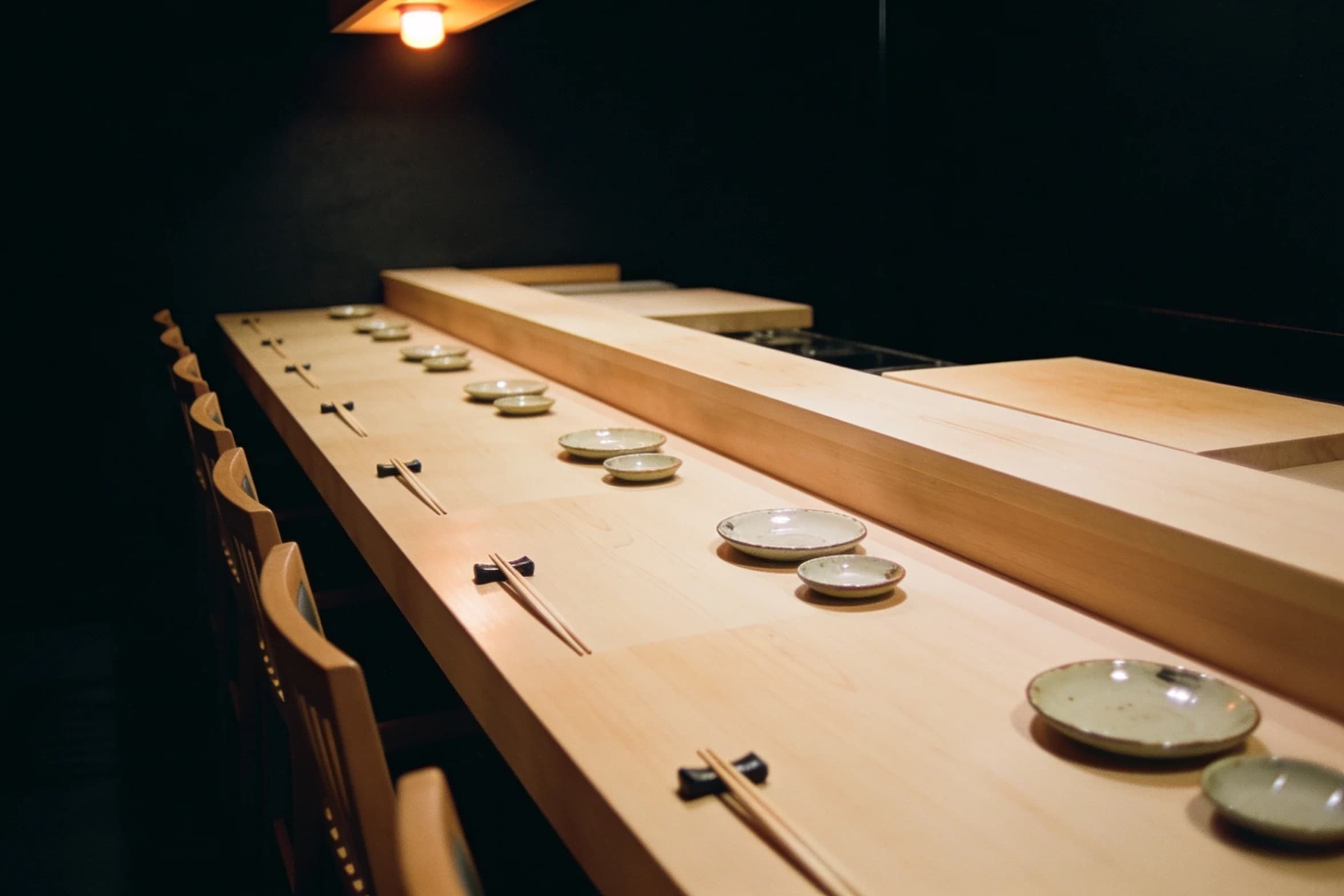
Tokyo. Do not tip, and this is not a case of it being merely unnecessary. Money left on a table creates a small problem for somebody, and a note pressed into a hand is quite likely to be returned, occasionally by a member of staff who has followed you into the street to give it back.
The equivalent gesture is to thank the chef properly on the way out, and to mean it. In a room with eight seats that carries considerably further than cash would, and it is remembered the next time you call.
The people who are not on the bill
This is the half that actually goes wrong, because none of these people appear on a printed total and all of them did something for you.
- The driver. Round up, or ten per cent on a long run out of a city. If the car came through the desk, ask us what has already been settled before you decide
- The coat check. A note, and the smallest one you have is fine. This is the one people try to solve with a card and cannot
- The doorman who stood in the rain until a car appeared. More than you think, and in cash, because there is no bill to add it to
- The sommelier, through the bill rather than by hand, unless you are paying cash, in which case the maître d’ will pass it on
- The hotel concierge who found you the table that was not available. Not on the night. An envelope at the end of the stay, and it is the best money spent on the whole trip
- Housekeeping, left daily rather than in one sum at the end, because it is rarely the same person twice
All of which needs cash in small notes, decided before you leave. One envelope in an inside pocket covers an entire evening and takes every one of these decisions out of the moment it would otherwise happen in.
Two things not to tip
The same service twice. Read the bill.
And your companion. The rate is agreed in advance, in writing, and it is for their time and their company. There is no gratuity line, nobody is waiting for one, and cash at the end of the evening changes the footing of something that was straightforward all night. If the evening went well, tell the desk instead. That goes on the file, it reaches them, and it is worth more to them than a note at the door.
Nobody at the table is watching what you leave. They are watching how long you take to decide it.
If it matters to you, ask before you go out. We book these rooms constantly and we know which ones add service, which ones expect cash at the door, and which ones will hand your money back. It is a question the desk answers in a sentence, which is a better use of a sentence than the thirty seconds at the end of dinner.