Ask anyone who has hosted a formal dinner what took the longest and they will say the seating plan. It is the one part of an evening that cannot be fixed once the room sits down, and it decides more about how the next three hours feel than the food, the wine, or the room.
For anyone arriving with a companion, it decides something else too: whether the evening is easy or whether it is a piece of work.
Why hosts split couples up
They are not being difficult. Traditional placement separates people who arrived together on the theory that they can talk at home, and that a table works better when nobody has a familiar shoulder to retreat into. As a theory about dinner parties it is largely correct.
It is also the arrangement that most often goes wrong for a client and companion who met three days ago through a booking form. Split across a table of twelve, your companion spends the evening fielding questions about you from strangers, without you within earshot to help.
A capable companion handles that perfectly well. It is still an unnecessary difficulty, and it is avoidable with one email.
The email to send the host
Send it a week out, not the day before, because the plan is usually drawn a week out and redrawing it is a favour you do not need to ask for.
Keep it to two sentences. Something on the order of: "If the plan allows, we would prefer to be seated together or opposite. Entirely your call and no trouble either way." That is the whole message. It gives the host a reason to accommodate you and a graceful exit if they cannot.
Opposite is often better than adjacent, and worth asking for by name. Sitting side by side means you talk to each other and to one neighbour each. Sitting opposite means you can catch an eye across the table, which is all the reassurance anyone actually needs, while both of you talk to four other people.
When the answer is no
Sometimes the plan is fixed. Corporate tables are often set by seniority, charity dinners by who paid for what, and weddings by a family politics you will never fully understand. Assume no and prepare for it.
Preparing for it takes about four minutes. Tell your companion who is likely to be near them, what those people do, and which subject each of them will raise. Two lines per person is plenty. It is the difference between a stranger and a person whose son plays rugby.
- Who they are likely to sit beside, by name and role
- The one topic each of those people always brings up
- Anything the two of you have agreed not to discuss, and the sentence that changes the subject
- Where you will be sitting, so a glance across the room finds you rather than searches
Round tables and long tables behave differently
The shape of the table decides how much the placement matters, and it is worth knowing which one you are walking into.
A round table of eight or ten is forgiving. Everyone can see everyone, the conversation tends to go general at least twice during dinner, and being seated three places apart is barely a separation. On a round table, ask for opposite and stop worrying about it.
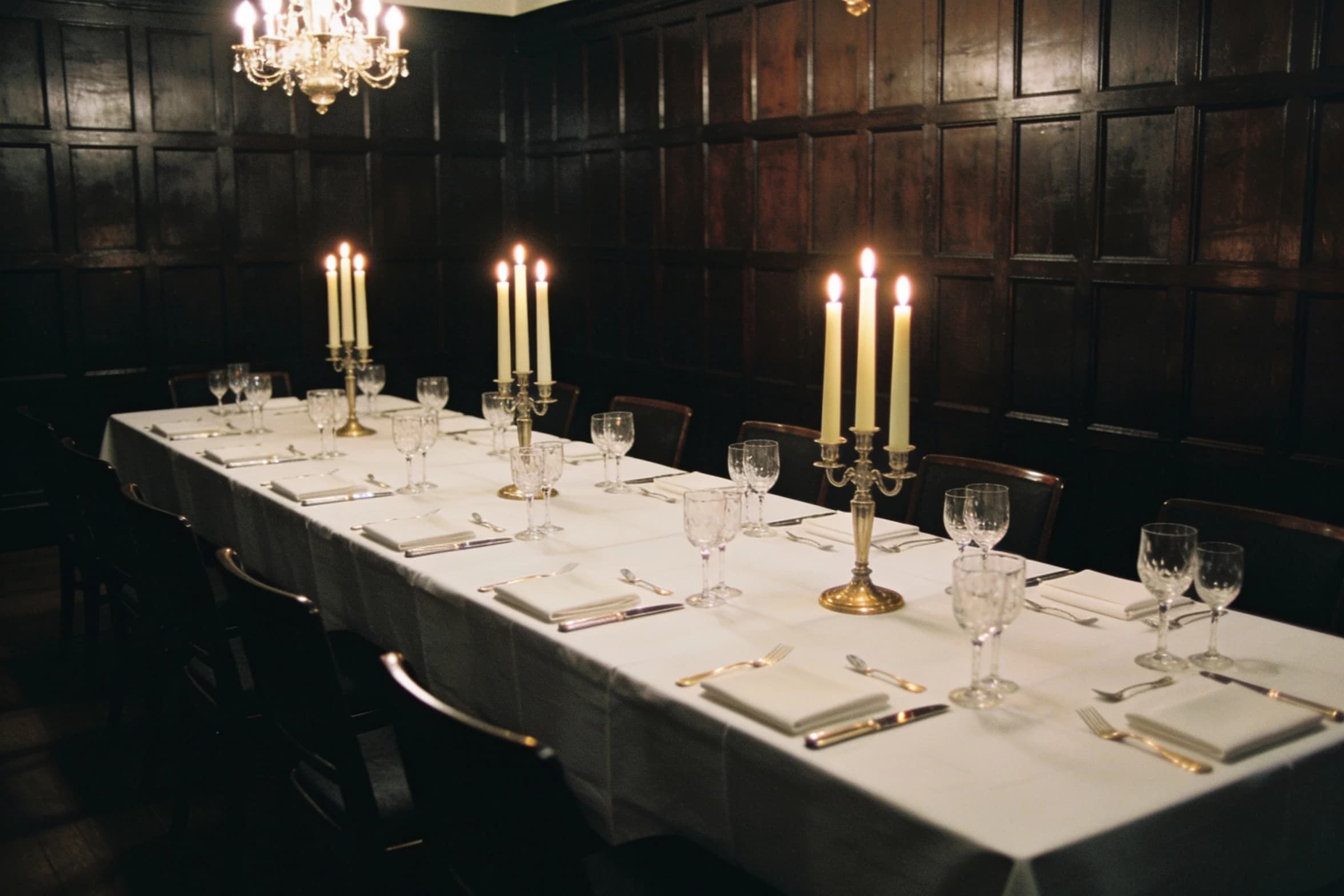
A long table is a different room at each end. Conversation runs in pairs and in fours, sightlines are poor, and a person seated eight places away is genuinely on their own for two hours. This is the arrangement where placement actually matters, and it is the one used at almost every corporate dinner.
The awkward case is the long table where you are seated on the same side, two places apart. You cannot see each other without turning, and turning to check on someone is the most visible thing you can do at a dinner. Adjacent or opposite. Two places apart on the same side is the one arrangement worth actively asking to change.
The mechanics on the night
Find the plan before drinks end. It is usually on an easel near the entrance or on a card at the desk, and thirty seconds in front of it tells you both where you are going. Walking to a table you already understand looks completely different from hunting for a place card.
Seat your companion first. Chair pulled, then your own. It reads as manners rather than performance as long as you do it without ceremony.
Introduce in both directions before the first course. Turn to the person on your companion’s far side and make the introduction yourself, with the role attached: "This is Claire. Marcus runs the Frankfurt office." You have now handed both of them a conversation and neither has to invent one.
A good introduction is not a name. It is a name plus the one fact that gives two strangers something to say next.
Being moved mid-evening
Long dinners sometimes move people between courses, and some hosts do it deliberately. If it happens, go without commentary. Objecting to a placement in front of a table is the only version of this that anyone remembers.
Agree a signal beforehand for the one case that matters, which is a neighbour who has become a problem. A hand flat on the table, a phone turned face down, anything you would both notice. It means come and find me. Used once in an evening it is invisible, and it is far better than a companion having to sit out forty minutes of something they should not have to sit out.
The part hosts remember
Write to the host afterwards and mention the placement by name if it worked. Hosts hear about the food constantly and about the seating almost never, and the seating is the part they agonised over.
It also means the next invitation arrives with your preference already remembered, which is the entire point of being easy to seat.
Tell us as well. We keep placement preferences on the client file, so the request goes out with the next booking without you having to remember to make it. Small, dull, and the reason regular clients stop thinking about any of this.